FM/QUERY PORTFOLIO

Type help for commands or search nine case studies.

← Work index / ID/X Partners x Rakamin Academy

Project-Based Internship Financial services

Loan Default Prediction

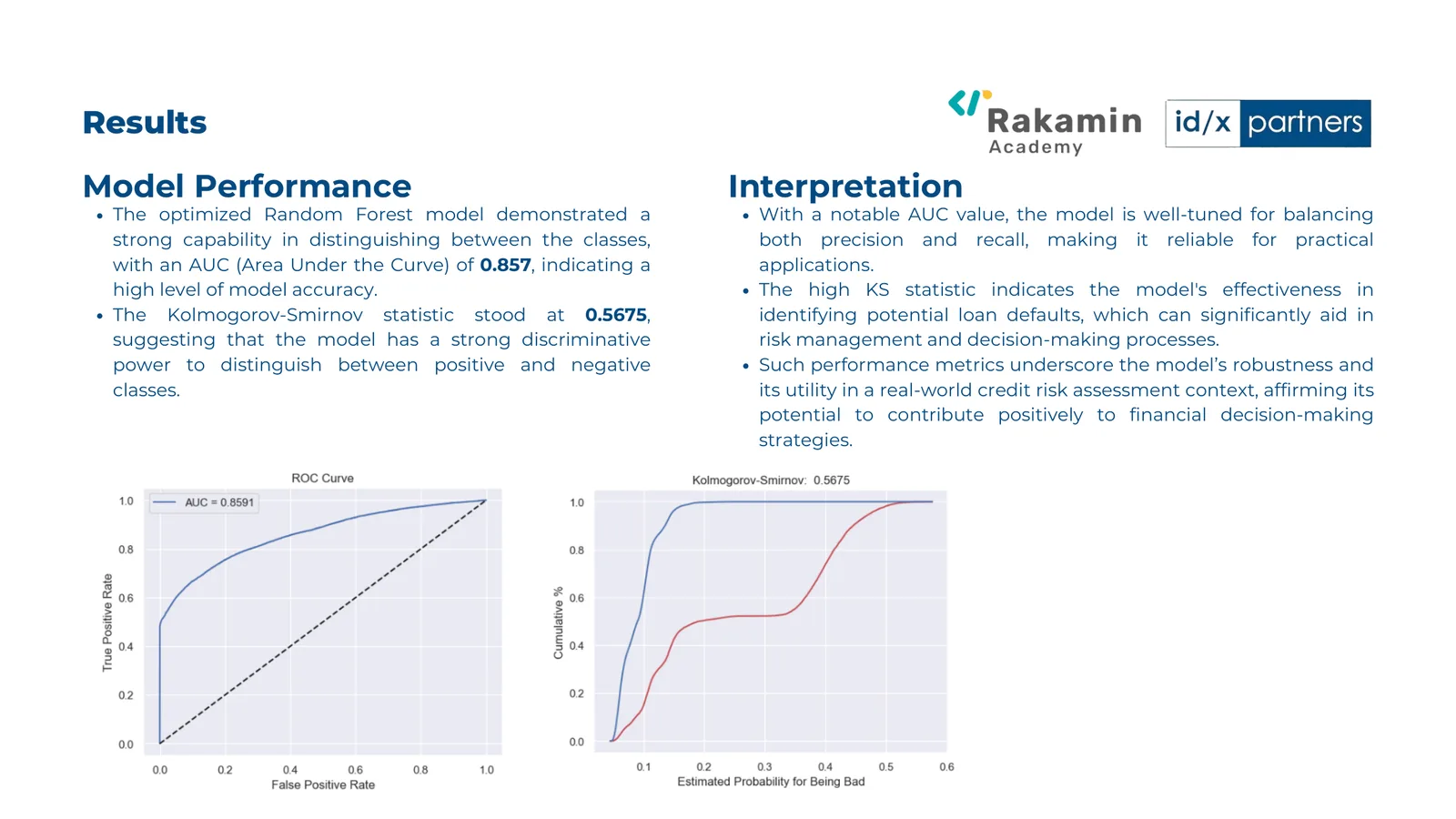
Developed and evaluated a Random Forest model for loan-default prediction, achieving an AUC of 0.857 and KS statistic of 0.5675 on the project dataset.

Loan default model results showing ROC and Kolmogorov-Smirnov evaluation charts
Organization
ID/X Partners x Rakamin Academy
Role
Data Scientist project participant
Timeline
Project-based internship
Stack
Python · Pandas · NumPy · Scikit-learn · Matplotlib · Seaborn · Jupyter Notebook
My role

My contribution.

Work I directly owned or delivered within the broader team effort.

  1. 01

    Prepared missing values, outliers, and derived features including debt-to-income and repayment ratios.

  2. 02

    Compared model families using exploratory analysis and a reproducible evaluation workflow.

  3. 03

    Applied stratified cross-validation and grid search, then evaluated the Random Forest with AUC and KS.

Analysis frame

Assumptions / constraints

  • The analysis uses a provided historical project dataset with more than 70 borrower and loan attributes.
  • Reported AUC and KS values apply only to the project dataset.
  • The model was not deployed; real use would require out-of-time validation, fairness testing, calibration, monitoring, and governance.

Technical judgment

Decision log

  1. 01
    Engineer debt-to-income, repayment-to-income, and tenure features.Why

    The high-dimensional source data required prepared predictors for repayment-risk analysis.

  2. 02
    Compare Logistic Regression, Decision Tree, and Random Forest using stratified cross-validation and grid search.Why

    Model selection required reproducible comparison under class-discrimination requirements.

  3. 03
    Select the optimized Random Forest.Why

    It was the chosen model among the compared families based on project evaluation.

Domain referenceMetric dictionaryView definitions +
AUC
Area under the ROC curve used to evaluate class discrimination.
KS statistic
Kolmogorov-Smirnov statistic used to measure separation between outcome classes.
Stratified k-fold cross-validation
Validation approach preserving class proportions across folds.
Calibration
Alignment between predicted probabilities and observed outcomes.

Snapshot

This project-based internship used a provided historical dataset to explore loan repayment risk across more than 70 borrower and loan attributes.

The situation

The exercise required a reproducible classification workflow for a high-dimensional lending dataset.

The problem

Missing values, inconsistent fields, outliers, and class-discrimination requirements had to be addressed before comparing model performance.

My responsibility

I prepared the data, explored distributions and relationships, engineered features, compared models, tuned the selected approach, and evaluated discrimination.

Approach

  • Engineered debt-to-income, repayment-to-income, and tenure features.
  • Compared Logistic Regression, Decision Tree, and Random Forest.
  • Used stratified k-fold cross-validation and grid search.
  • Evaluated AUC and KS.

Solution

The optimized Random Forest was selected from the compared model families and documented with the evaluation reported by the project.

Outcome

The project report recorded AUC 0.857 and KS 0.5675 on the project dataset.

Limitation: This was not a production lending deployment. Real-world use would require out-of-time validation, bias and fairness testing, calibration, monitoring, and governance.

What I learned

Model discrimination is only one layer of lending risk. Validation design, fairness, explainability, calibration, and operating governance determine whether a model is usable.

Outcome Validated evidence

What changed.

Published outcomes stay within what can be supported by project evidence.

Random Forest AUC of 0.857 on the project dataset

KS statistic of 0.5675 in the project report

Compared three model families

Related assets

  • RepositoryNot public

Contact Continue the conversation

Want to discuss how this system was built?